
(Step 1 of 9 in the Bed Bugs Killer Ultimate Guide - Updated March 3, 2020)
Here’s one of the most important bed bugs facts you need to know and understand:
Bed bugs are survivors. You need to understand bed bug habits to give yourself a fighting chance to get rid of them for good. No matter what method you use to kill bed bugs, chances are, you're looking at an ongoing process that may last weeks or months. Even if you hire a professional exterminator, this is not going to be an overnight job.
You must be both thorough and patient, because getting rid of bed bugs requires killing multiple generations of these pests. Not only do you have to kill the adults but their bed bug larvae to ensure they won't come back.
What makes this all so difficult is that there are so many places the adults and their eggs can hide. The video below shows what you're up against.
Why Facts about Bed Bug Matter
Never forget this fact about bed bugs: You won't get rid of them until you kill the last bed bug standing in your home. That means you have to wipe out multiple generations of bed bugs — adults and their children at every stage of bed bug development.
To do this, you need to know what bed bugs look like and where you'll find them at each of their 7 stages of development. Miss one stage and you'll need to start your efforts all over because one female adult can produce up to 500 new bed bugs during her lifetime. And as many as 80% of bed bug eggs survive to adulthood. And they each start the cycle all over again.
Getting rid of bed bugs for good isn't hopeless, but you do need to understand what you're up against. These bugs are survivors. And they thrive on our ignorance of their habits.
Bed Bugs Facts and Pictures
Bed bugs, Latin name Cimex lectularius L., are insects that feed themselves by feasting on your blood.
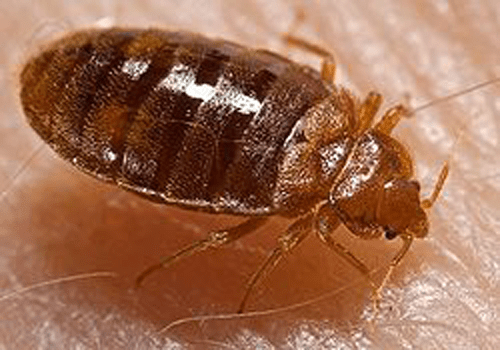
Baby Cimex lectularius L. ©smuayc.
How to Identify Bed Bugs
In appearance, they are flat, reddish-brown, and oval-shaped. Adults are about 3/16-inch long. After biting you, they look plump and red because they're full of your blood. Their flat bodies also make it easy for them to hide in cracks and other very small spaces.
Can You See Bed Bugs with the Human Eye?
Yes. In fact, watching them scurry across bed sheets is one of the most frequent ways people discover they have bed bugs.
So, how big are bed bugs?
Well, imagine a reddish apple seed with legs, moving quickly — very quickly — across the bed.
As the comparison with the dime below makes clear, bed bugs are small but big enough to be seen by the naked eye.
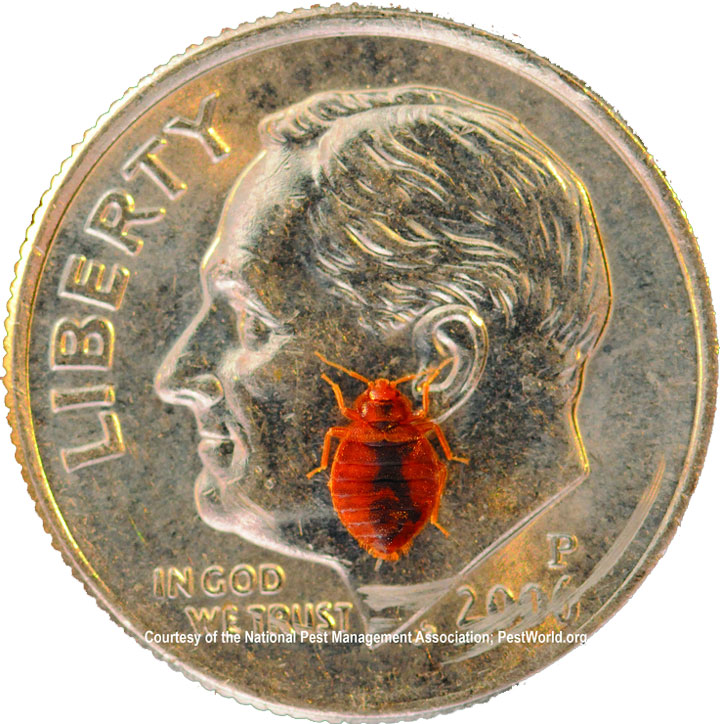
Bed bug - dime size comparison. Photo courtesy of the National Pest Management Association, PestWorld.org.
Can Bed Bugs Fly?
No. Although they have wings, they're stunted. So bed bugs can’t fly.
Can Bed Bugs Kill You?
No. But they can sure make your life so miserable you might wonder if you'd be better off dead.
Do Bed Bugs Bite?
Oh, my goodness, yes! In fact, those bites are one of the telltale signs that you have bed bugs.
People have different reactions to those bites. Some people can develop rashes that bring plenty of misery. But bed bugs won't give you any diseases.
And no, bed bug bites are not contagious.
How Long Can Bed Bugs Live without Feeding?
One of the things that makes them so difficult to get rid of is that they can live for up to a year without a new meal. But the chemicals approved to fight them last less than three months. So you may think you have gotten rid of them only to find you have new bed bug bites months later.
What Attracts Bed Bugs?
You do. Rather, your body heat and the carbon dioxide you exhale when you breathe attract bed bugs. Short of giving up breathing, there's nothing you can do about this.
Bed bugs secrete themselves during the day and then come out to feast on you throughout the night. Right before dawn is when they're most likely to eat.
Where Do Bed Bugs Come From?
Exterminators report having treated infestations in:
- Homes, including vacant homes
- Apartments
- Condos
- Hotels and motels
- Offices
- Schools and Dorm rooms
- Stores
- Movie theaters
- Buses, subway cars, and other public transportation
- Military barracks
- Libraries
- Laundromats
- Cruise ships
- Hospitals
You can add to that some recent embarrassing public outings of infestations in restaurants and upscale multinational retail stores. Even the Empire State Building isn't safe from these hungry creatures. In short, bed bugs go where they can find human meals.
Bed bugs get around because they're silent travelers who can quietly attach themselves to your clothing, pets, purse, suitcase, or even the bags you bring home from that expensive department store.
And they're equal opportunity invaders; they thrive in every environment from the cleanest to the dirtiest, from the poorest to the richest, in small towns and big cities, across all regions of the country and internationally.
That means you can, unknowingly, bring bed bugs into your home at any time from a wide range of places.
It also means that thorough deep cleaning alone will not get rid of them.
Facts about the Bed Bugs Life Cycle
To get rid of bed bugs, you have to destroy them at every stage of their life cycle.
Consider this, the average female bed bug lays eggs after every meal. That means every time she feasts on your blood, she celebrates by making a new generation to ensure her lineage continues.
The time it takes a bed bug to develop from an egg into an adult capable of reproducing is about 37 days. During that time the bed bug will pass through 7 different stages of maturity.

Bed bugs evolve through 7 stages of life:
Stage | Size | Behavior |
|---|---|---|
Egg | 1 mm (0.04 in.) | Hatch in about two weeks and become 1st stage larva |
1st Stage Larva | 1.5 mm (0.06 in.) | Molts (sheds skin to grow to the next stage) after eating |
2nd Stage Larva | 2 mm (0.08 in.) | Molts (sheds skin to grow to the next stage) after eating |
3rd Stage Larva | 2.5 mm (0.10 in.) | Molts (sheds skin to grow to the next stage) after eating |
4th Stage Larva | 3 mm (0.12 in.) | Molts (sheds skin to grow to the next stage) after eating |
5th Stage Larva | 4.5 mm (0.18 in.) | Molts (sheds skin to grow to the next stage) after eating |
Adult | 5.5 mm (0.22 in.) | Feeds multiple times over several weeks; lays up to five eggs every day |
It takes seven stages of development for bed bugs to evolve from eggs into mature adults, and five of those stages are as larvae.
Blood meals precede each new stage. Before a nymph bed bug (stage 1) can shed its skin (called molting) to allow it to grow into a larger one, it must consume a blood meal — that is, bite someone.
How often do they come out to eat? About every 3 to 7 days.
If a nymph fails to find a blood meal, it stays at that stage of development until it feeds successfully.
But bed bugs are survivors, and 80 percent of all eggs survive to become reproductive adults. That's bad news for you if you have bed bugs.
After 5 successful moltings, the egg develops into an adult bed bug.
This complete process takes about 37 days.
Bed Bug Adult Behavior
Once it's an adult, a bed bug can reproduce. But first, you guessed it — male and female bed bugs must consume a blood meal.
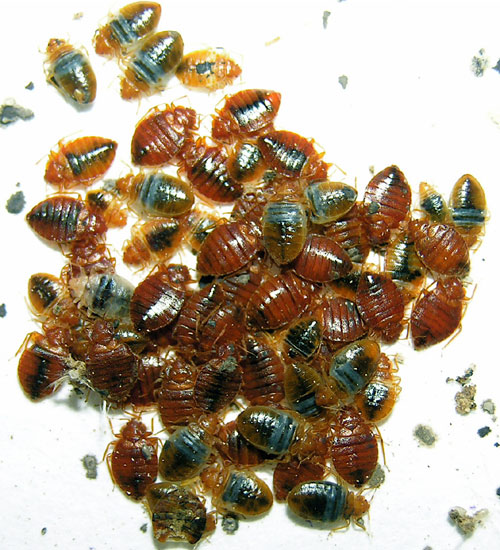
Adult bed bugs after consuming a blood meal. Females lay up to 5 eggs a day after their meal. Photo by A. L. Szalanski, 2007. CC BY-SA 3.0
Females lay up to 5 eggs a day and as many as 500 in a lifetime.
With regular access to blood meals, bed bugs can live about one year.
Bed bugs like to live within about 3 feet of their prey, which is why most are found in bedrooms, couches, and other places where humans like to sleep.
Once a suitable meal is found (you or your pet), a bed bug will feed on you for about 3 to 10 minutes.
When finished, the bed bug returns to its hiding place — usually some kind of crack or crevice nearby. Typically, other bed bugs are also hanging out there.
Once tucked away safely, the bed bug digests and excretes its meal. So when you find bed bug excrement, it's a good indication that bed bugs live nearby.

Facts About Bed Bugs That
Make Them Hard to Kill

Bed bugs are skilled survivors. Here are some of the things that aid their survival:
- They can live for up to a year without a new blood meal. If you’re using methods that leave behind just two bed bugs, they can start a whole new population weeks or months later. It’s as if you never got rid of them because you didn’t.
- They usually only come out at night. The night time is the right time for bed bugs to be with the one they love most: you. As a sleeping victim, you’re not likely to ever see them while they feast.
- They are silent eaters, so they’re unlikely to endanger themselves by waking you.
- Their food sources are diverse. They include humans, birds, family pets, and farm animals, such as hogs. Basically, if you have a pulse and give off heat, you’re fair game.
- They are heat-seeking missiles when it comes to scouting out and finding food. Your body heat and carbon dioxide are like aromas calling out from the kitchen to them. If bed bugs live in your house, they will always find their food supply – you.
- They can hide undetected in your bedroom for months while they continue to eat, mate, lays eggs, and molt.
- They prefer to rest and hide on wood and paper surfaces.
- Over time, their hiding spaces become filled with feces, molted skin they shed, and old egg shells. This gives off an odor that is recognizable by other bed bugs as a safe haven.
- They are prolific reproducers. A female lays eggs after each meal. Each female can produce up to 500 eggs in her lifetime. Those eggs become adults, capable of reproducing, within 37 days. It’s truly a never-ending cycle. With these stats, the bed bug population in your home can double about every two weeks!
- Bed bugs lay eggs about every 7 days. This makes it important to time the reapplication of your treatments to cover new eggs.
- Bed bug populations can remain incognito for several generations, even with professional exterminators looking for them.
- They can use birds’ nests on your roof or near your home as their launching pad for entering cracks and other opened barriers to your home.
- They live close to their food: in the seams and under the buttons of your mattress, between the mattress and box springs, in headboards, in wall cracks, under carpet, inside your couch and other upholstered furniture, in the frames of furniture, beneath the drawers in your nightstands, behind wall hangings, and under decorator pillows on your bed, couch, or floor. It seems like they're everywhere because they are.
- Newer generations of bed bugs have become resistant to some traditional bed bug killers, such as pyrethroids. Many are smart enough to avoid cracks where pyrethroids have been sprayed previously.
Bed Bug Signs
How can you tell if you have bed bugs? Look for signs.
Unfortunately, the first sign most people get that they have a problem is they're getting bitten. Here are some other bed bug signs:

Bed bug eggs (white spots), excrement (dark spots), young bed bugs and adult bed bug. Photo courtesy of louento.pix CY 2.0.
- Blood on your sheets left behind after a bed bug feeds
- Black bed bug excrement
- Clumps of small, white or yellowish bed bug eggs; bed bugs glue their eggs into clumps in their harborages, or hiding spaces
- Empty egg shells
- Molted skins
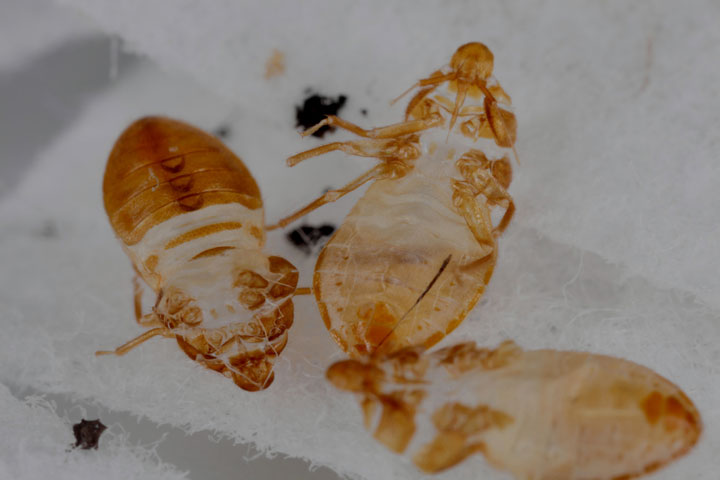
Bed bugs shed skin. Photo courtesy of louento.pix. CY 2.0.
Sooner or later, bed bugs always make their presence known. The smell of your carbon dioxide and body heat is too powerful for them to stay away for long.
Next: Detection Guide
Now, you're armed with basic bed bugs facts that will help you understand their habits. But, you still need to know how to kill them. Here's the single most important thing you must know about getting rid of bed bugs: You must find ALL of their hiding places. To do that you need to know how to detect bed bugs.